![[Official] APA Hotels & Resorts](/features/shared/apa-logo-en.png)

01
Walk beneath the autumn leaves
Morning light, the crunch of fallen leaves, steam rising beyond the slope. The trip begins long before you reach the inn.
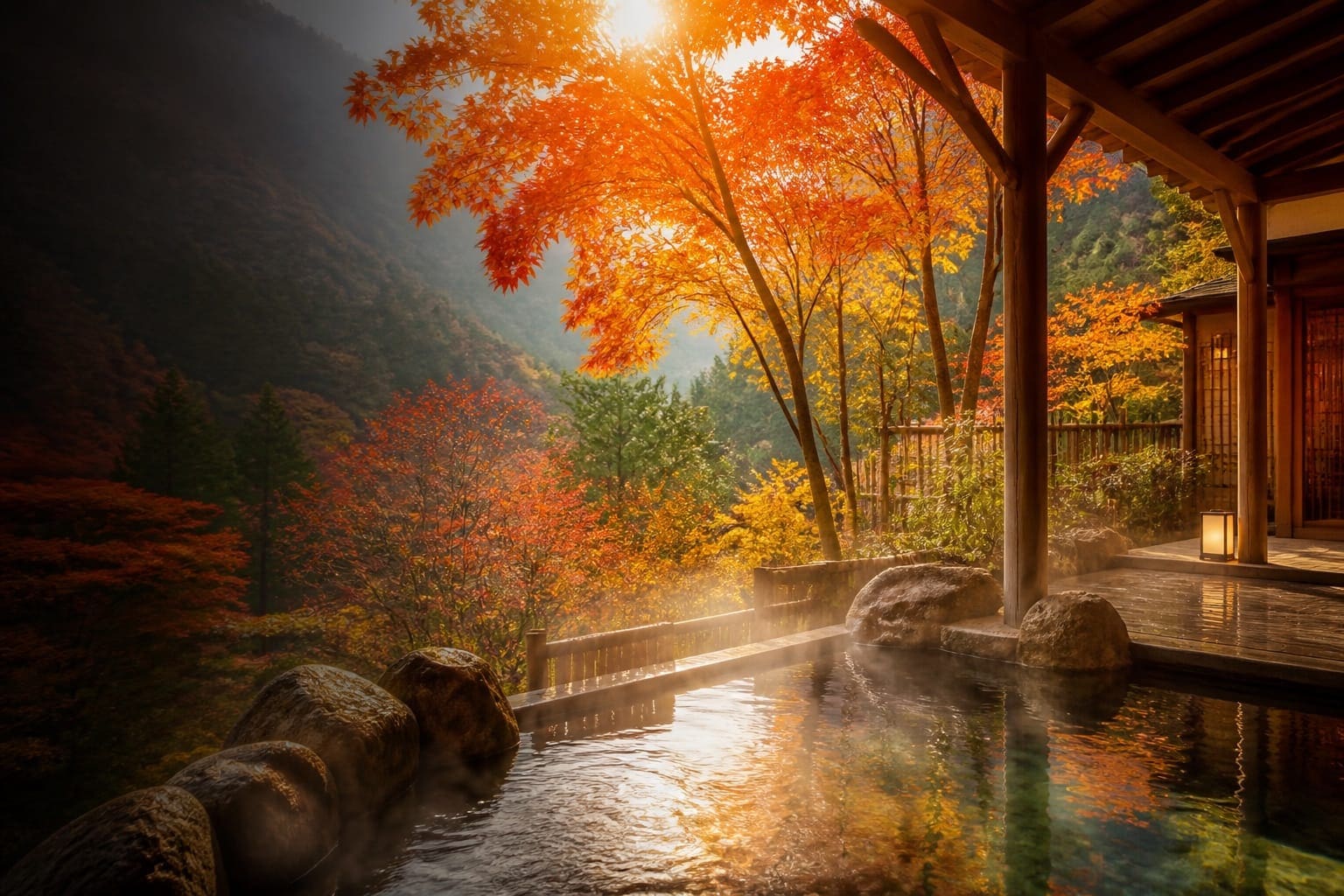
Autumn-leaf paths in the morning, rising steam by night.The kind of autumn trip you'll want on your next days off — scenery and unhurried hours at the inn.
Autumn Invitation
In autumn, the deepening color you see and the hours you spend at the inn both feel calm and unhurried. Spend those hours — the ones only autumn brings — at an inn you have been saving for a season like this.
Morning light, the crunch of fallen leaves, steam rising beyond the slope. The trip begins long before you reach the inn.

Mushrooms, chestnuts, rice cooked with seasonal ingredients, local sake. Food is where a place shows the season that belongs to it alone.

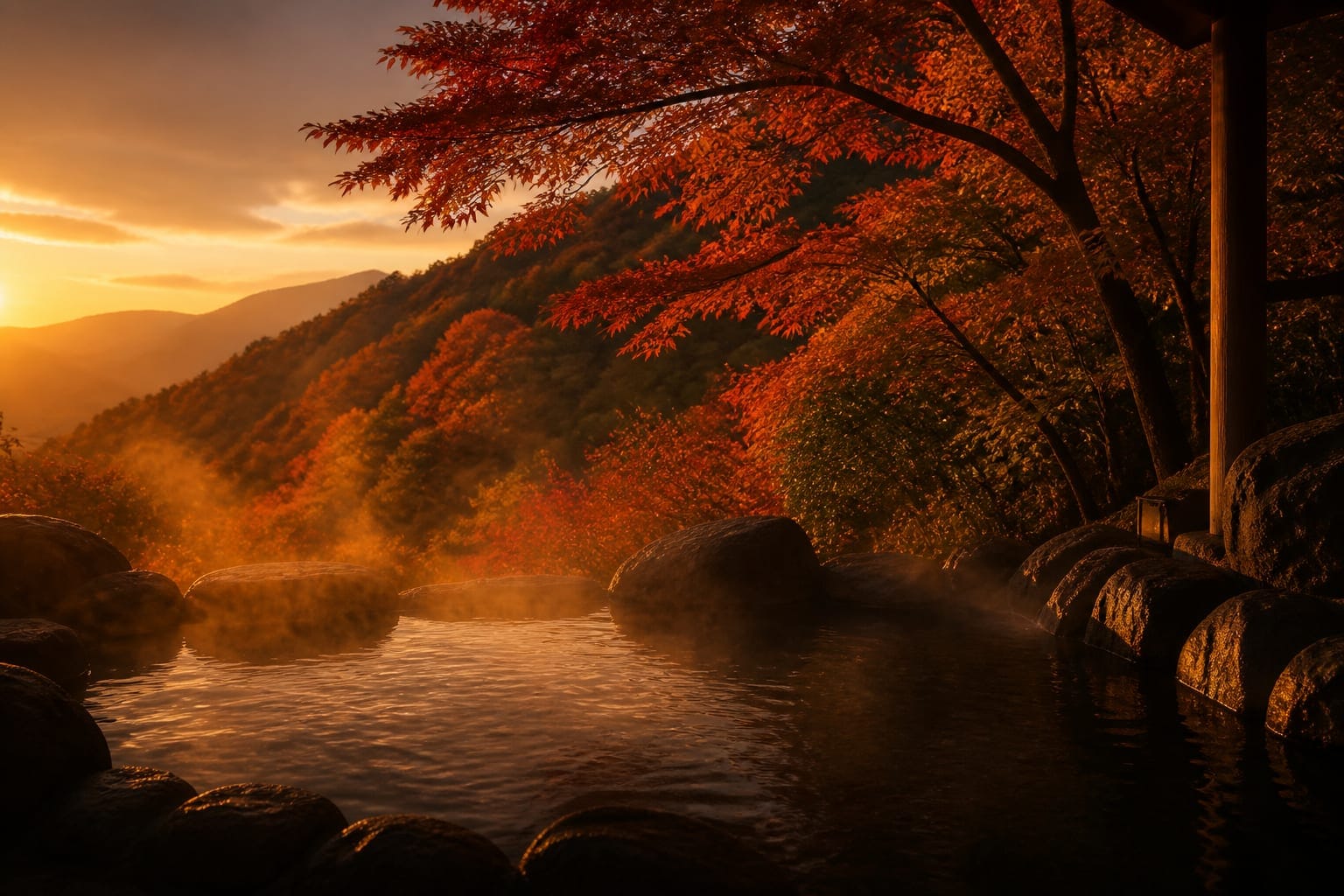
With the warmth of the water around you, you watch the mountains take on color and the season shift. A beauty you would pass by in daily life spreads quietly through you.
Katayamazu, Ishikawa — Kaga Katayamazu Onsen
APA Resort Kasuikyo
Availability & rates at apahotel.com
Myoko, Niigata — a plateau 600 m up
APA Hotel & Resort Joetsu-Myoko
Availability & rates at apahotel.com
Atami, Shizuoka — the heights above Ajiro
Sanga, Atami
Availability & rates at apahotel.com
Yufuin, Oita — Yufuin Onsen
Satoyama Safu, Yufuin
Availability & rates at apahotel.com
59 inns across Japan
Wide skies, lakes and the hot springs of eastern Hokkaido. Here the drive itself becomes the trip.

A cabin-style sauna, and a 360-degree view from the top floor
Natural hot-spring water straight from its own source, with a rotenburo (open-air bath) and a cabin-style sauna. The top-floor observation room turns a full 360 degrees over the fields and bridges of Tokachi, with swans in season. Welcome milk on arrival and a dog run on the grounds are this inn's own touches.

Soft, free-flowing water, and an automatic loyly sauna
Onneyu Onsen's water — known here as bihaku-no-yu — runs soft and faintly slippery, gensen kake-nagashi, straight from the source and never recirculated. An automatic loyly sauna sends steam over the stones every 20 minutes, beside a reclining bath and a cold plunge. Dinner is an 11-course kaiseki set, or a 70-dish Japanese-Western buffet with seafood rice bowls.

Ezomae sushi shaped by a master, and 100% free-flowing spring water
A food-first inn: dinner is Ezomae sushi shaped by a master from fish caught in nearby waters; breakfast, a seafood rice bowl you heap yourself. Yunokawa Onsen water arrives 100% gensen kake-nagashi, free-flowing from the source, and there is a heated stone-bed bath. Five minutes by car from Hakodate Airport, ten on foot from the Yunokawa tram stop.

Lake Abashiri, seen from view baths on two floors
Yobito-no-yu, the view baths on the third and fifth floors, look out over Lake Abashiri. The rooms face the lake too, and the newer Hanasarasa wing holds special suites. Breakfast brings a seafood rice bowl you build yourself, and you can choose your pillow at no extra charge.

Moor hot-spring water, a Hokkaido Heritage, flowing free outdoors
Tokachigawa Onsen's moor hot spring, chosen as a Hokkaido Heritage, fills the large indoor bath and the rotenburo (open-air bath), flowing free from the source. 162 rooms, with a sauna and a jet bath. Breakfast is a buffet of around 40 dishes — Tokachi yam, kattedon you assemble yourself, bread baked that morning.
Gorges, lakes, castle towns. Tohoku inns where you can savor autumn leaves and rising steam.

An open-air bath facing the Hakkoda range, and a stone-bed bath too
Twenty-four rooms, and a rotenburo (open-air bath) facing the Hakkoda mountains. The bathhouse adds a sauna, a cold plunge, a heated stone-bed bath and a falling-water bath, all fed by natural spring water flowing free from the source. Breakfast starts at 6:40 a.m. — handmade by the kacchan, the local women who cook it, from ingredients grown nearby.

Ten minutes from Akita Station: a warming salt spring and kiritanpo hotpot
Satomi-no-yu is a sodium chloride spring: the kind that holds its heat long after you get out. There is a women's open-air bath, a men's ceramic one, and a sauna. Dinner is a kaiseki built around kiritanpo hotpot — pounded rice simmered in broth — with three meats on a ceramic grill: Akita beef, Hachimantai pork and local chicken.

Shrine-carpenter woodwork, and silky water straight from the source
Seventy-two rooms, and a lobby whose ceiling was raised by miyadaiku, the carpenters who build Japan's shrines and temples. Yamanokami is among the most abundant springs in Hanamaki, and its faintly silky water runs gensen kake-nagashi, free-flowing from the source. Breakfast is a 32-33 dish Japanese-Western buffet with hittsumi, an Iwate dumpling soup.

All 119 rooms face Lake Gosho
All 119 rooms face Lake Gosho, so the lake and its seasons sit right in the window. The baths run across two floors: Hitorijime-no-yu on the second, Nanbu Magariya-no-yu on the third, styled after the region's L-shaped farmhouses. Breakfast is a Japanese-Western buffet of more than 40 dishes from Iwate.

Hop between Jomon garden baths, with drinks included
The garden baths take Jomon-era forms — one a stone circle, one a pit dwelling — and the bathhouse beside them holds a hinoki cypress tub, a ceramic tub styled after Nanbu ironware, and a dry sauna. Going from one to the next is the pleasure. Dinner is a festival buffet of home cooking from all 33 municipalities of Iwate.

A view bath on the sixth floor, mineral flakes in the water
Thirty-seven rooms drawing Oshuku Onsen water 100% gensen kake-nagashi, free-flowing from the source. The sixth-floor view bath alternates daily between a marble tub and a Japanese-style one. All-inclusive, 20 drinks on free pour, and breakfast at Zen, the irori-hearth dining room.

A waterfall-view open-air bath, and an all-Yamagata breakfast
A rotenburo (open-air bath) looks onto a waterfall, with a sauna beside it and Sakura, a private bath for up to four. The Hoo breakfast buffet runs three live kitchens, with imoni taro stew and a tasting of three Yamagata eggs. Shogi and go sets are lent free.

Three springs, eight baths — a whole onsen tour without leaving
A member of the Japan Association of Secluded Hot Spring Inns. Three separate springs feed eight tubs you can work your way through, and the slippery unagi-yu, or eel water, is the inn's pride. Rooms are few, and every guest dines in a private room. Naruko Gorge, at its finest in autumn, is close by.

Nine rooms with a kitchen, and Lake Inawashiro from the lounge
Nine rooms, and a second-floor lounge that takes in Lake Inawashiro. The dining room comes stocked with a rice cooker, induction hobs, pots and tableware, so you can cook for yourself. The bathhouse downstairs is a bicarbonate spring, the kind that leaves the water feeling soft. Table tennis and karaoke are free.

A cuisine-first ryokan whose in-room baths run its own spring
Twenty-two rooms, and a spring of its own — a rarity in Higashiyama Onsen. Rooms come with open-air baths or view baths cut from Aomori hiba cypress or Shigaraki ceramic, so the inn's own free-flowing spring water is yours alone. Dinner is a kaiseki chosen by the head chef, and a gallery of Aizu lacquerware sits in the building.

One of Japan's three oldest springs, in a cypress bath
No recirculation, no filtration: 100% free-flowing from the source. Iwaki Yumoto counts among Japan's three oldest hot springs, said to have opened in the Nara period, and here you take it in a hinoki cypress bath built by cypress specialists. Dinner is a Japanese set meal with Yonezawa beef on a ceramic grill, and yukata come in children's sizes.

A historic free-flowing spring, and a handmade Japanese breakfast
Ten minutes on foot from JR Yumoto Station: 28 rooms, a free-flowing open-air bath left deliberately wild, and a large indoor bath. Tatami rooms run from six to twenty mats, and one is styled Hawaiian after the Onsen Musume characters. Rice and miso soup come with free refills at breakfast.

A waterfall below, and four private view baths to choose from
The Sennin-buro bathhouse and its open-air bath run on the inn's own spring, flowing free from the source, with four private view baths besides. Takimi-no-yu looks straight down on the Harataki waterfall; Tsukimi-no-yu sets two round Shigaraki ceramic tubs side by side. Breakfast is a Japanese set meal with a small buffet alongside.
Hakone, Yugawara, Isawa, Minakami. Onsen trips close enough to make in a weekend.

Six rooms, every bath private — free-flowing water the inn is proud of
Six rooms in Shima Onsen, and three baths, every one of them yours to book privately — the open-air Takimi-no-yu among them. Dinner is served in Rakuan, a dining room built around an irori hearth, where Joshu beef on a hot iron plate is one of the choices. In the rooms, the river runs within earshot.

A hot-spring bath on every room's river-view terrace
Every room comes with its own natural hot-spring open-air bath, and every room looks out on the Tone River. The bathhouse adds an automatic loyly sauna and an outdoor space to cool off in. Dinner changes with the season, and Minakami Station is a 15-minute walk.

Owakudani water, yours alone for 45 minutes, around the clock
Hot-spring water drawn from Owakudani, taken in private 45-minute sessions at any hour, day or night. Rooms, baths and terrace all face the same way, out toward the sun as it comes up over Sagami Bay. A small inn, with dinner served in a restaurant that takes reservations only.

Two saunas, three family baths, and everything included
Fifty-five rooms, run all-inclusive. Beside the Togen and Yugen bathhouses stands Spa Sauna Manyo, with a view sauna and a healing sauna; three family baths besides. Breakfast is included in the rate, and a free shuttle runs from the station.

A taiko drum show every night, and two great open-air baths
The bathhouse runs on the inn's own spring, flowing free from the source, and two large open-air baths sit beside it: Rokkasen in stone, Hanahinoki in cypress. Dry and mist saunas round it out. Dinner brings Koshu wine beef and hoto noodle hotpot, and every evening ends with the Keizan taiko drum show.
The food and hot springs of Shinshu, Hokuriku and Niigata. An autumn of mountains and water.

A highland resort at 600 m, facing the Myoko range
Built on a plateau 600 meters up, with the Myoko mountains rising straight ahead. The open-air bath in the grand bathhouse is natural hot-spring water (diluted, heated and filtered), with a sauna alongside. The hillside deck — a lookout over Mt. Myoko by day, with bonfire evenings on set dates — is free to use, and the RRR restaurant serves a buffet built on Hokushin'etsu produce. About 45 minutes by car from Joetsu-Myoko Station; a free shuttle runs by reservation up to the day before.

A shrine in the courtyard, and two springs of different character
Twelve rooms and two waters of quite different character: a metasilicic acid spring in the bathhouse, a chloride spring in the open-air bath. Past the lobby, a shrine stands in the courtyard, open to visit at any hour. Breakfast is served in the Kawaratei dining room, and Joetsu-Myoko Station is seven minutes away by car.

Undiluted spring water, and a theater troupe in the building
One hundred percent spring water, with nothing added to dilute it. The soft, faintly carbonated water fills the ground-floor open-air bath and, upstairs, the baths named Danshaku and Kifujin. At Kawaraza, the in-house theater where troupes from Asakusa — home ground of Japanese popular theater — take the stage, laugh and cry the evening away.

A tatami tea-room open-air bath, and Uonuma Koshihikari rice
The Kaiun open-air bath is floored with tatami, like a tea room, and a seasonal kaori (fragrance) bath is filled each month with a different medicinal infusion. Breakfast runs to some 70 items — Uonuma Koshihikari rice, local vegetables, wild mountain greens — and the house rolled omelette is made in front of you.

Rooms with a sunken hearth, and three named private baths
Sixteen rooms built in the sukiya style of the tea house. Three private baths, named Muyuju, Sarasoju and Bodaiju after sacred trees, offer reclining pools and falling-water jets, with simple sulphur spring water available 24 hours. Some rooms are built around an irori hearth, and dinner is the Shinanoji kaiseki, drawn from whatever is in season in Shinshu.

Bathe in the original source of Kamiyamada Onsen
Twenty-four rooms drawing yumoto water — the original source that has flowed since Kamiyamada Onsen first opened. The black-granite and red-granite bathhouses and the view open-air bath stay open day and night. Rooms look out on the mountains of Joshinetsu and the roofs of the onsen town, and there is a table-tennis corner.

Untouched free-flowing water around the clock, and a foot bath
Spring water with nothing done to it at all, flowing free around the clock. The water that fills the tubs comes locally vouched for. Inside you will find a foot bath to gather around, a lobby beside an irori hearth, and Japanese-modern rooms with beds set on tatami.

Toyama Bay shrimp and nodoguro, bought by a chef-turned-owner
The owner trained as a chef and buys Toyama Bay's catch straight from the market, so the kaiseki runs to shiroebi sweet shrimp, nodoguro rosy seabass and grilled crab. Thirty rooms, standing among the scattered farmhouses that spread out from the Shogawa gorge, with a deliberately wild open-air bath and a private family bath.

Two bathhouses: a sunlit dome, and a great circle of moon
Taiyoden sits under an open dome; Meigetsuden traces the wide circle of the moon. The two alternate between men and women, and the inn has 84 rooms. Dinner is a seasonal kaiseki taken in one of 14 private dining rooms, each named for a phase of the moon, and an annexe offers rooms with open-air baths.

Hokuriku's largest garden bath, and a stone-oven theater buffet
A garden open-air bath billed as among the largest in Hokuriku, a silk bath — the first in Awara — and a carbonated bath, across 170 rooms. The Jusan-no-kaze rooms come with a semi-open-air bath of their own. Dinner is either a theater-style buffet built around a stone oven in an open kitchen, or a seasonal kaiseki.

Lake Shibayama, seen from a 15-meter-long view bath
Tamayura, a 15-meter view bath counted among the finest in Katayamazu Onsen, takes in Lake Shibayama and the Hakusan range in a single sweep. The sauna, added in December 2023, comes with a cold plunge and room to cool off outside. Meals are built on what Hokuriku has in season — matsutake mushrooms in autumn among them.
The sea of Izu, the castle town of Inuyama. A trip built on scenery that keeps changing.

Eight rooms, every one with an open-air bath, 160 m above Sagami Bay
An eight-room inn on a steep slope above Ajiro in Atami, more than 160 meters up. Every room has its own open-air bath, and Sagami Bay spreads out below. Dinner is Japanese kaiseki built on local and Izu produce; breakfast leans on seafood too. Ten minutes by taxi from Ajiro Station, about 30 from Atami.

A 6,600 m² Japanese garden, and private open-air baths downstairs
Twenty-two rooms set around a Japanese garden of 2,000 tsubo, about 6,600 square meters. Ground-floor rooms come with a private open-air bath, and the main bathhouse looks out on Mount Katsuragi by day and the stars at night. The garden is lit after dark, and drinks and sweets at the book cafe are free.

Every room faces the sea, and one of Japan's 100 best sunsets
Every room faces the sea — the same stretch of water chosen as one of Japan's hundred finest sunset views. Beyond the view bathhouse and the ocean-front rotenburo (open-air bath), a lounge sits behind 39 meters of window, where the drinks are free. Breakfast is served in a room with the same wide view.

Three private baths, free to use, and stars to bathe under
A small inn of 11 rooms with three private baths, each of a different character. They cost nothing, and you can use them as often as you like whenever one is free. On a clear night you can bathe looking up at the stars, and some rooms have an open-air bath on their own terrace.

Inuyama Castle from the bath, and tatami corridors throughout
From the garden open-air bath called Kazane you look across the Kiso River to Inuyama Castle, a National Treasure; in autumn the leaves join the view. Shoes are left at the entrance, and the corridors throughout the building are laid with tatami. Dinner is the Hakutei kaiseki, with Hida beef, and Inuyama-Yuen Station is about eight minutes on foot.
Nara, Kyoto, Wakayama. Wander through ancient capitals, and slow down in onsen towns.

A cloudy source bath said to be the only one in Kansai
A cloudy mineral water said to be found nowhere else in Kansai. At 21,574 mg of dissolved minerals per kilogram it is unusually concentrated, and it is neither recirculated nor chlorinated — the baths are drained and refilled every day. The pleasure here is moving back and forth between the 26°C source bath and the 41.5°C main bath.

A Nara-period court banquet, and a festival ground after dark
Forty rooms, and a table that reaches back to the eighth century: Tempyo no Utage, a court banquet reconstructed from Nara-period cuisine, alongside a Yamato kaiseki. In the evening a festival ground opens with target shooting and ring toss, for families to enjoy together. A garden open-air bath draws on Horai Onsen, whose name means 'fortune arrives'.

The sun setting into the Sea of Japan, from a single-rock bath
Yuhigaura, named among Japan's hundred best places to watch the sun go down, lies directly in front of the inn. From an open-air bath carved out of a single rock you can watch the sun drop into the Sea of Japan. The water is an alkaline spring, soft enough that it feels slippery on your hands, and a 100 m² suite comes with a terrace and a hot-spring jacuzzi.

Five minutes from Kawaramachi, Kyoto kaiseki served in your room
About five minutes on foot from Hankyu Kawaramachi Station. The head chef has been honored as a Contemporary Master Craftsman of Kyoto Prefecture, and his Kyoto kaiseki is served in your room at both dinner and breakfast. Forty tatami rooms, a large bath in the basement, a stream running through the lobby, and the garden's autumn leaves beyond it.
Toward Izumo and Dogo. Shrine visits and town strolls, with room left for the baths.

On the lakeshore, you can even sleep in a glamping dome
The inn stands on the shore of Lake Jinzai, with rooms and a lounge that look out over the water. Its spring, Koryo Onsen, rises from 1,100 meters down and comes up soft and smooth. Seven air-conditioned glamping domes sit on the grounds, with barbecues out on their terraces, and breakfast brings sea bream shabu-shabu and clam soup.

Free-flowing hot spring, in a different tub in every room
Seventeen generous rooms of 33 to 42 m², each with a bath of its own design, all fed by free-flowing natural hot-spring water. Breakfast is made entirely in-house: Ehime jakoten fishcakes, bread from a local bakery, and a burger you put together yourself.
Centered on Yufuin: autumn views of Mount Yufu, and the hot springs at its foot.

A stone open-air bath in all eight rooms, straight from the source
Eight rooms, each with a stone-built open-air bath of its own. The water is 100% gensen kake-nagashi, free-flowing from the source, and it is yours at any hour, with the trees of the Japanese garden in view. Fifteen minutes on foot from Yufuin Station; bicycles for hire.

Mount Yufu from all seven rooms, one step off the main street
Seven traditional tatami rooms, all facing Mount Yufu, in eight-, ten- and twelve-mat sizes. Men's and women's baths each pair an indoor pool with an open-air one, and there is a private family bath. Dinner draws on produce from Yufuin and around Oita. Above all the inn offers quiet — one step in from the bustle of the main street.

On Yunohira's stone-paved street: private baths, no booking needed
On the stone-paved street of Yunohira Onsen, an inn of seven rooms. The private bath Kagono splits into a hinoki cypress indoor pool and a rock-built open-air one; with two family baths besides, you can use whichever is free, as often as you like, without booking. Dinner is satoyama country cooking: fried yamame trout, Oita wagyu, vegetables from nearby.

Three parties a day, with Mount Yufu from a terrace bath
Three villas, each built to a different concept, taking three parties a day. Every terrace has an open-air bath fed straight from the source, and from the water you look out at Mount Yufu and the trains running past. Dinner is at dining kurogane; breakfast is served in your room.

Walk to Lake Kinrin, with three free-flowing baths
Yunotsubo street and Lake Kinrin are both close enough to walk, and the inn has eight rooms. Three kinds of bath: a free-flowing communal one, a private open-air bath, a private indoor bath — the private ones need no booking, so use them whenever they are free. One cottage has an open-air bath hollowed from a single rock.

Rice from the inn's own paddy, and free-flowing baths in the rooms
An 18-room ryokan that serves rice at breakfast grown in its own Yufuin paddy. The men's and women's bathhouses keep their indoor pools open around the clock, and there is a family bath you can have to yourselves. Some rooms come with a free-flowing rock bath facing Mount Yufu, others with a Shigaraki ceramic tub.

All four baths are private, and the cottage takes pets
Six rooms and four baths — two open-air, two indoor — all of them private, and yours to use whenever one is open. The cottage is rented whole, takes pets and has its own washing machine. Yufuin Station is eight minutes away, and there are bicycles to borrow.

Amid rice fields, with a source bath in every room
Seven minutes' walk from Yufuin Station, with rice fields on every side and ten rooms in all. Each room has a bath of its own, fed straight from the source, and the kumiko latticework and stained glass around the building were made by the staff themselves. One cottage is entirely step-free, which suits families traveling together.

A cat cafe, and three private baths facing Mount Yufu
Five rooms, and three private baths — two indoor, one open-air — with Mount Yufu in view from the baths and some of the rooms. The Waraneko garden took the owner four years to build, and the cat cafe beside it (junior-high age and up, charged separately) adds to the stay.

A rare spring the locals once called medicine water
Five minutes on foot from Yufuin Station, this ten-room inn draws on one of the few springs in the area long valued as kusuri-no-mizu, medicine water. A brick-built bathhouse and a private open-air bath; the rooms, 42 to 63 m², face Mount Yufu. Breakfast brings ryukyu, an Oita speciality of marinated fish, and a small hotpot of Kin'un pork.

Every room a cottage with two baths, the water all yours
Ten free-standing cottages, each with an indoor bath and an open-air one. The water is soft and silky, and in your own bath it arrives free-flowing, exactly as it comes from the ground. Dinner is a kaiseki course in a private dining room; breakfast, a Japanese set meal built on the inn's own vegetables.

Water rising unaided from 500 meters down, into your own bath
Eight single-story rooms, each with a hot-spring bath of its own. The water rises unaided from 500 meters down, hot and strongly mineralized. Large men's and women's open-air baths face Mount Yufu, and self check-in lets you go straight to your room without stopping at a front desk.

Five baths, all of them private, and a corner for children
Twenty-one rooms and five baths, all of them private. Some rooms come with a hinoki cypress conservatory bath or a ceramic semi-open-air tub. Breakfast is a buffet of vegetables gathered that morning, with tofu alongside. There is a children's corner with picture books, and Yufuin Station is seven minutes on foot.

Free-flowing baths open around the clock, five minutes from the station
Thirty-one rooms, five minutes' walk from Kyomachi Onsen Station, with free-flowing natural hot-spring water available around the clock. Alongside the indoor and open-air baths there is a family bath at 1,200 yen an hour. Breakfast is a Japanese set meal with freshly cooked Hinohikari rice grown locally in Ebino.
KOYO SEASON
Typical peak-foliage periods by region, to help you plan your dates.
| Region | Sep | Oct | Nov | Dec |
|---|---|---|---|---|
| Hokkaido | early Sep – early Nov | |||
| Tohoku | late Sep – late Nov | |||
| Kanto | early Oct – mid Dec | |||
| Hokushinetsu | late Sep – early Dec | |||
| Tokai | early Nov – early Dec | |||
| Kansai | early Oct – early Dec | |||
| Chugoku & Shikoku | late Oct – late Dec | |||
| Kyushu | late Oct – early Dec |
Timing varies from year to year. Check local tourism boards for current conditions.